Shannon Liang is a Rotterdam and New York-based artist who works with video, installation, performance, and writing to explore themes of memory, loss, power, and connection. Drawing from psychoanalytic and spiritual perspectives, her work often reflects on personal and cultural histories, particularly the impact of erasure and absence.
A continuous practice of self-archiving—collecting videos, photographs, and journal entries— forms the foundation of her work.This impulse stems from her family history: her parents grew up during China’s Cultural Revolution, a period marked by propaganda, incarceration, and silence. Growing up in the U.S. without many cultural references to the Chinese immigrant experience, she turned to recording as a way to witness, remember, and make visible what might otherwise be lost.
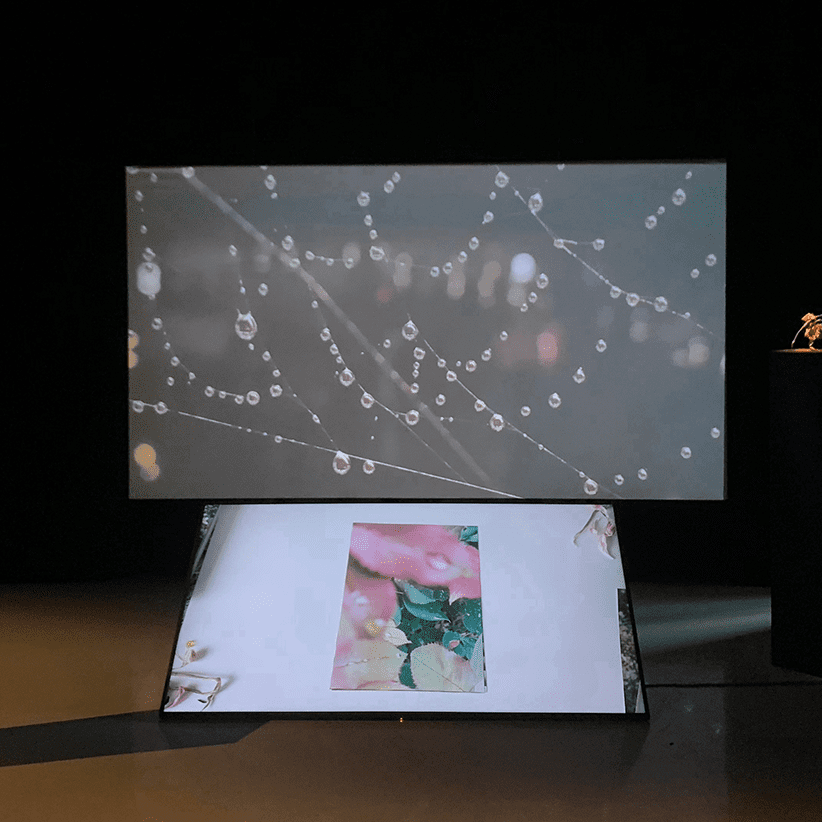
Her works often take an empathetic approach, imagining the inner lives of everyday things—a grocery store tulip, a discarded object on the sidewalk, pigeons on a balcony.Through this lens, her art becomes both a therapeutic act, processing emotions and reinterpreting personal narratives, and a spiritual practice, finding meaning and connection in the ordinary.
Using accessible tools like a phone camera, she captures moments impulsively, prioritizing immediacy over technical precision. Her process involves revisiting and reworking these materials over time, allowing images and words to evolve and take on new meanings.This cyclical approach mirrors the way people make sense of difficult experiences—by revisiting, reframing, and finding new layers of understanding.
Hands are a recurring presence in her work—grasping, stroking, tearing, selecting.Whether interacting with flowers, photographs, or tarot cards, these gestures become a way of feeling, communicating, and connecting.Vision is another central theme, appearing as both a literal and metaphorical device that speaks to memory, imagination, and the shifting nature of perception— what is seen, what is hidden, and what might still come into view.