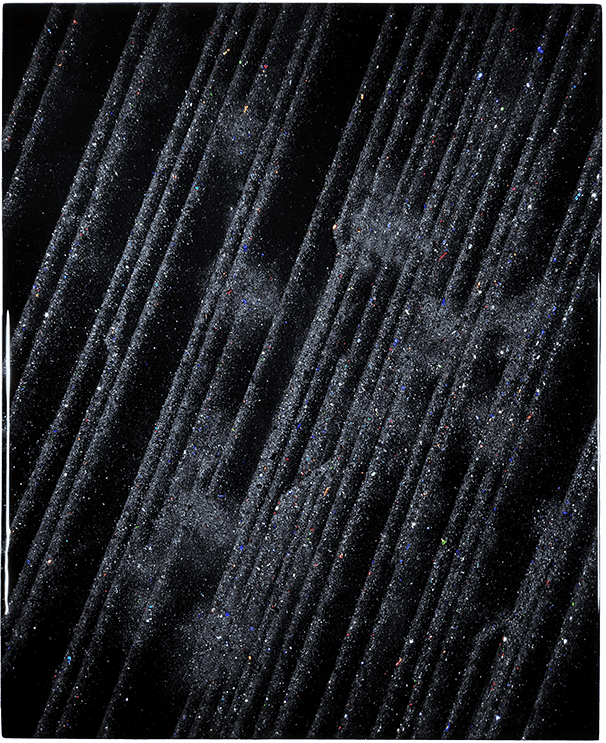
The most profound revelations await in the delicate fissures between broken pieces. Showcasing at JPS Gallery Tokyo, "Between the Fragments" orchestrates an unprecedented dialogue between quantum physics and feminist body reclamation through the visionary works of Jiwon Kim and Naoto Fuchigami. Though their approaches appear diametrically opposed—Kim meticulously stitching fragmented female forms on Hanji paper to transform societal wounds into healing narratives, while Fuchigami deliberately pulverises pristine silicon wafers into elemental dust—they converge at a remarkable intersection where truth and beauty flourish not in wholeness nor in fragmentation alone, but in the electric territories between.
Jiwon Kim : Stitching Rebellion Against Beauty Standards
At the heart of Kim's soul-stirring creations lies an intimate act of rebellion against conventional beauty standards. Working primarily with traditional Korean Hanji paper, she transforms the female form into profound statements on identity and self-acceptance. Her distinctive process— deliberately fragmenting, distorting, and exaggerating body forms before meticulously stitching them back together—transcends mere artistic technique to become a deeply personal ritual of healing and purification.
Each deliberate stitch represents Kim's response to her own journey of overcoming bodily complexes and society's relentless aesthetic expectations. This fragmentation and restoration serve as a powerful metaphor for the universal human journey toward self-acceptance. Through her work, Kim challenges viewers to confront their relationship with societal pressures and discover the authentic beauty that emerges when we embrace our natural forms—transforming vulnerability into strength and imperfection into art.
Naoto Fuchigami : The Philosophy of Technological Dust
In magnetic counterpoint, Fuchigami's work exists at the electrifying intersection where quantum science meets primal artistic expression. With his revolutionary "ℏ Series," he transforms silicon wafers—the semiconductors that form the backbone of our digital civilisation—into raw, elemental forms that challenge our fundamental understanding of reality itself.
By methodically grinding semiconductors into fragments and powder, Fuchigami enacts a symbolic ritual—returning technology to its base material state. This deliberate deconstruction of what contemporary society values reveals profound truths about humanity's cognitive limitations while simultaneously critiquing our tendency toward oversimplification across disciplines. His process unmasks the uncanny properties of elements composing our reality, challenging how we categorise, interpret, and verbalise our understanding of existence.
Fuchigami's compositions generate a visceral tension between order and chaos, precision and ambiguity, scientific certainty and philosophical questioning. By imbuing industrial materials with meaning through the unique lens of quantum physics, he offers viewers a rare glimpse into the mesmerising contradictions underlying reality while expanding artistic expression's boundaries into new, uncharted territories.
Fragments of Truth : The Art of Technological and Bodily Deconstruction
In the extraordinary dialogue between Jiwon Kim and Naoto Fuchigami's work, we witness a revelatory exploration of humanity's complex relationship with fragmentation and reconstruction. From the pristine silicon wafers that drive our digital acceleration to the intimate wounds of body dysmorphia that this same technological society inflicts, these visionaries illuminate a profound truth: our most authentic connections with reality emerge precisely when we challenge the frameworks through which we perceive existence.